Introducing, "Smoke, The Flavor of Guatemala" & Stories From StoveTeam International

Dear Friends of StoveTeam International,

I am thrilled to announce that StoveTeam’s very first cookbook, "SMOKE: The Flavor of Guatemala" is ready for you to enjoy. This cookbook was conceived with a powerful purpose to shed light on the devastating global issue of open-fire cooking as well as to showcase the abundance and beauty of Guatemala and its remarkable people. 

Cookbooks are not just recipe guides; they are windows into the heart and soul of a culture, a region, or a cause. Through these pages, you'll find a captivating collection of recipes and stories that reflect the heart and soul of Guatemala, a land filled with rich traditions and flavors. In it, we also tell the story of StoveTeam International and the many dedicated volunteers and individuals who invested their time and energy to bring clean cooking solutions to families in Latin America. While we gathered a treasure trove of stories from supporters, cooks, farmers, and staff during its long production, we couldn't include them all. Over the next months, we'll be sharing some of these remarkable stories and recipes with you. 

With "SMOKE," we hope to grab your attention and we hope that you'll join us in spreading the word to others about StoveTeam’s work. By purchasing this cookbook, you are not only treating yourself to a delightful culinary adventure but also contributing to StoveTeam International's life-saving work. Through your support, we are saving lives, creating jobs, and protecting the environment, one cookstove at a time. 

Thank you for joining us on this incredible journey. Your support is invaluable, and we are immensely grateful for it.

Sincerely,

Shelby Kardas Executive Director, StoveTeam International

Get Your Copy Of “SMOKE: The Flavor Of Guatemala” Today

Interview With Elvis Estuardo Godínez Pérez, Farmer & Natural Science Teacher In Guatemala

Hello, my name is Elvis Estuardo Godínez Pérez. I am a proud Guatemalan Farmer and teacher. I was born in San Antonio Aguas Calientes and I have lived my whole life in this municipality. My family is part of a mayan kaqchikel community and since I was very young I saw my father and my grandfather work hard to allow me to attend school. This is how I studied and became a teacher at the elementary school. Afterwards, I obtained my college degree which allowed me to teach natural sciences for middle school students. After working as a teacher for 3 years, I gained experience that gave me a much wider perspective on the world around me and from these experiences I developed even bigger dreams and goals. At that time, I set out to find a way to help people in the agricultural sector. This is why I went back to college to study agricultural engineering with a specialization in farming production. I am currently in my last semester and I am very interested in the idea of developing cooperatives with farmers. The idea behind the cooperative is to provide decent jobs for farmers, for them to be able to pay for their medical expenses and provide their children with an excellent education.

Can you talk about what you grow?

Since I was little I have worked in the coffee fields, helping my grandfather with his lots. Currently, I’ve gained experience growing various plants, but mainly broccoli, pumpkins, maze and beans. 

What’s it like being a farmer? What are the challenges? 

Being a country person in Guatemala is very hard. Farmers wake up at 5:00am and work all day until very late at night. You work under the hot sun, you use a mattock for digging and chopping, and a machete. It is basically a very physically demanding job. One of the biggest challenges that one faces is the uncontrollable weather, since the lots are not irrigated, you must wait for the rainy season to be able to grow vegetables. You live everyday hoping that the rainy season will be long enough to fulfill the crops’ needs and that it will not be so stormy so it doesn’t kill the plants. 

What do you need to make a good crop? 

To make a good crop you need good seeds, that are resistant to droughts, plagues and diseases. In Guatemala, the volcanoes and the rain are key ingredients to making a good crop. The volcanoes’ ashes provide nutrients and help conserve the humidity within the soil, which increases the plants’ growth. It is a delicate balance though because if there is too much ash, it will kill the vegetables. The rain, on the other hand, is vital for crops so they can produce healthy vegetables and grains. Farmers need a very good climate, sun, and rain, or they must install an irrigation system that keeps the plants alive. 

What do you like to grow? 

I love growing vegetables so my family can cook as many meals as possible. For example, we grow carrots, squash, and tomatoes. The volcanic soil in this area is so rich that it provides many nutrients for the crops. This allows the roots of the plants to grow deep and strong, which is great for agriculture. I am very connected to the soil, to nature, the countryside, and the fresh air that it offers. However, I am also very conscious that my experience is different than other farmers since I did have the opportunity to study and receive a college education. I decided to come back to the land. Others don’t have the choice. They farm to survive. 

What’s your favorite meal? 

My favorite meal is my grandmother's pepián. See the recipe below for pepián de pollo.

Any other interesting facts you’d like to share?

Life in the countryside can be very beautiful, but, unfortunately, farmers in Guatemala are not well paid for the difficult and important job that they do. It takes approximately three months to produce vegetables and by the time produce arrives at the market, customers are always negotiating for the cheapest prices, even though the starting price is already extremely low. 

–Elvis Estuardo Godínez Pérez, Farmer and Teacher in Natural Sciences

Honoring Our Founders, Nancy Hughes & Gerry Reicher

Reflection From Nancy Hughes,

“Designing a Stove With Larry and Gustavo”

One day Larry Winiarski, having heard me speak at a Rotary presentation, knocked on my door. It was from Larry that I learned it wasn’t all about burns; it was the smoke from indoor cooking fires causing the pterygium and respiratory problems I’d witnessed firsthand. 

Later, Larry called me from El Salvador to say he had designed a stove for me, and that he had also found Señor Gustavo Peña, a smart, energetic, local Salvadoran to produce it.

At the weekly Southtowne Rotary Club meeting I told everyone I was going to go to El Salvador to meet a guy who wanted to make stoves. I said, “I have no idea what we’ll do, but does anyone want to join me?”

Much to my surprise, Gerry Reicher, an introverted, retired professor; Don Steely, a smart, energetic guy who wore a prosthetic leg; and our veteran volunteer, Gail Norris, the one wearing the Mickey Mouse hat in Playa Grande, offered to join me. 

I had no idea then that this group of incredibly smart, compassionate, and energetic retirees would be the foundation of an international initiative that not only gave us an excuse to travel, but one I am proud to say continues to this day. 
When we landed at the airport in San Salvador, Larry was there to greet us, dressed as usual in a pair of well-worn overalls. Pointing to a tanned, energetic Salvadoran in his late-50’s, Larry introduced me to Gustavo in English, “Nancy. THIS is Gustavo.” 

Señor Gustavo Peña was totally prepared and brought out an Excel spreadsheet of our appointments for the week. Gustavo rushed us to his ancient Kia saying, “We need to hurry as our first appointment is with the Vice Minister of the Environment”. I learned later that enterprising Gustavo wasn’t shy about approaching anyone to talk about his new venture.

I was excited and glanced nervously at the stove in the trunk; we pitched Don’s prosthetic leg in the back so we could all squeeze in, and excitedly made our way to the elegant Ministry of the Environment. 

Later, Larry stood at the front of the conference room before a group of government functionaries and a white board; and, still in his tattered overalls, carefully explained how this small, “rocket stove” worked.   

The handsome and well-dressed, bi-lingual, Vice Minister who had been waiting in his office, wandered into Larry’s presentation. He looked at the drawing of the Ecocina, a round metal bucket with a single hole in the top and another on one side. He said that it looked a bit like a toilet, and he wasn’t sure people would accept it, but even so, he was interested in seeing how it worked. I held my breath, hoping the stove would be acceptable.

Don and Gerry rushed back to the car, dragged the stove out of the trunk and then onto the grass in the backyard. The Vice Minister ambled around the corner to find a liter pot and filled it with water. 

Feeling nervous, and acting on faith as I hadn’t yet seen the results of Don, Larry and Gustavo’s efforts, I hoped for the best as we gathered a bit of trash wood from the formal garden. Larry lit the stove, and, with only four small sticks of wood, and not even a bit of smoke, the heat came out of the top at 1,000° F. The little stove boiled the liter of water in less than eight minutes -- the same as a microwave.

Later testing of Larry’s design would show an 86% reduction in carbon emissions and particulate matter and a 56% reduction in wood usage. 

The Vice Minister was impressed, and much to our surprise and delight, announced, “I like it. It does look a bit like a toilet, but we have about five and a half million dollars for a project like this. What is your capacity? ....” 

Five and a half million dollars?  Was he kidding? Our capacity was two stoves. We knew then that we definitely weren’t ready. 

Later, it was Gerry, always the voice of reason, who said, “Listen. We have a great product. We have a man who wants to produce it, and we can raise money.” I realized at that moment that Gerry would be instrumental in implementing this new plan and that I couldn’t give up. Whatever might be happening, one thing was clear: working with stoves to protect the women and children in Central America was my future.

– Nancy Hughes, Founder, StoveTeam International

Don Steely, Nancy Hughes, and Gerry Reicher

Gustavo, Gerry, Larry, and Don working on an Ecocina

The History That Shaped StoveTeam

StoveTeam International 2007-2022

As we celebrate over 15 years as an organization, we look back with appreciation upon the years leading up to StoveTeam’s founding, as well as our many phases of growth working in Central America. Read on to learn about the many passionate individuals, groups, and donors that formed StoveTeam and continue to shape the organization’s trajectory as we plan for 2023 and beyond.

Help provide a stove

Travel to Nicaragua with StoveTeam's Executive Director

Nicaragua

I have just returned from two weeks of travel with StoveTeam’s Board Chair, Kim Forrest, and Christadelphian Meal a Day of the Americas board members to visit all three of our partner projects in Guatemala, El Salvador, and Nicaragua. This month I’m happy to share some of these photos and experiences with you….

Employees of the Avanza Factory in Estelí, Nicaragua

CMADF Board Member Matthew Swift with Elida Olivas, Shelby Kardas & Kim Forrest

The last stop on this journey is Estelí, Nicaragua to visit Elida and Nelson Olivas and our team of stovebuilders at Fabrica Avanza. After a little snag at the airport, we finally arrived at the factory space, and much to our surprise, Elida and Nelson had literally laid out the red carpet …. The factory space was transformed into a party venue, and it looked pretty great! We were in a festive mood after traveling all day and happy to share a great meal and music with the Avanza Factory employees, stovebuilders, and members from two coffee cooperatives who are helping to identify stove recipients in the outlying communities. 

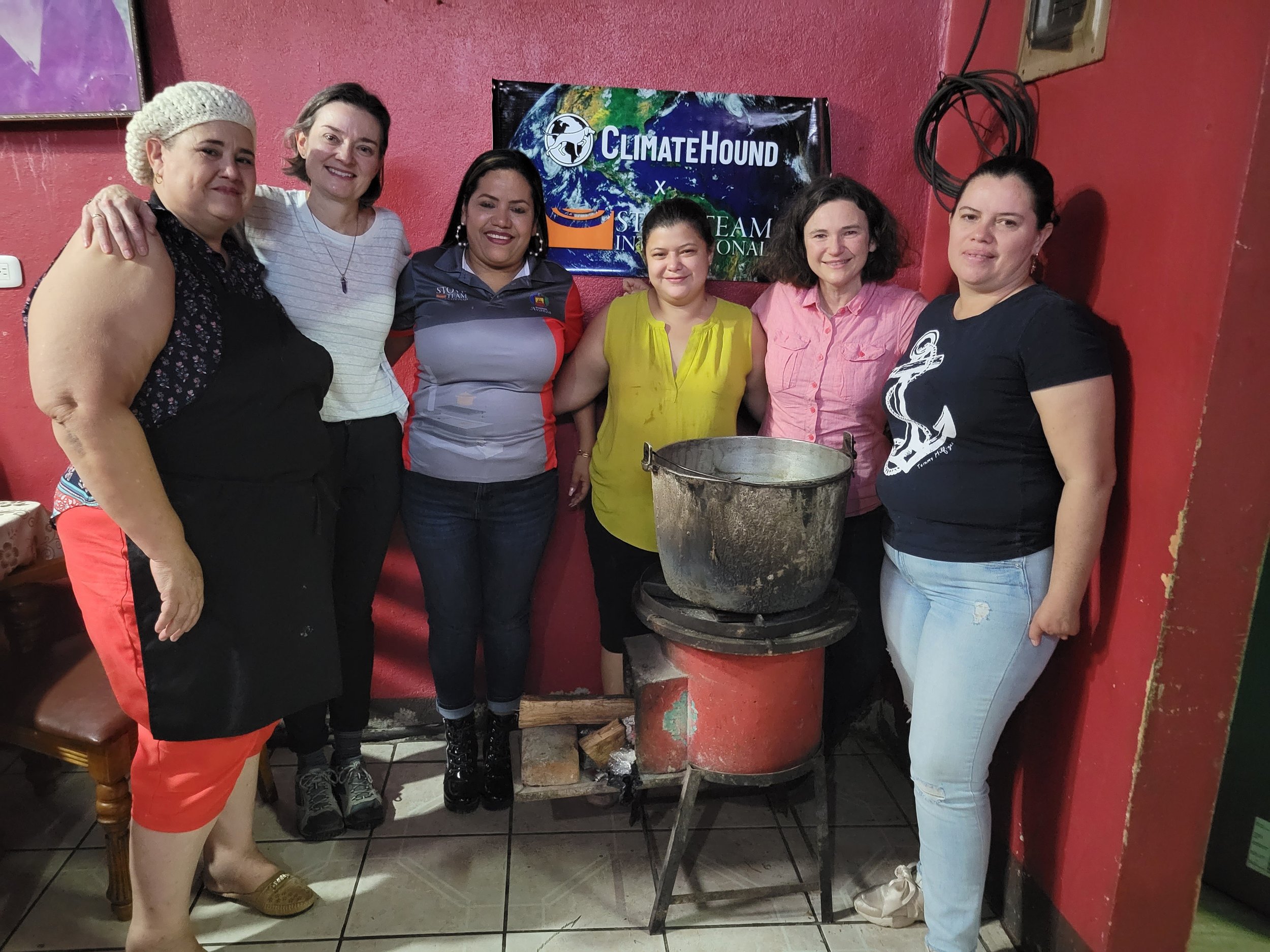
The next day, we were back to our purpose and happy to see that Elida Olivas, factory owner, is very successfully selling the portable Ecocina cookstove to local families and that her husband Nelson is applying his many years as a stovebuilder to now oversee the expanding Justa project in Nicaragua. We also announced a new partnership! ClimateHound is now sponsoring the placement of Ecocina cookstoves in Nicaragua to help the food and beverage industry of North America offset its carbon footprint.

ClimateHound founder and CEO Palmer Fox says, "Our company's mission is to help our clients -- from beverage producers and bars to restaurants and food and beverage festivals -- to calculate their impact and reduce it in ways that are meaningful to the planet and to their customers. Nothing could speak to our community more than helping other communities, like those served by StoveTeam, to cook and feed themselves safely, and we are proud to be the exclusive sponsor of Ecocina stove production and distribution in Nicaragua.” 

We also had fun doing a live cooking show with a woman entrepreneur who runs a family business cooking and selling hundreds of the Nicaraguan, specialty, nacatamales using her portable, Ecocina cookstove. Click here to see the live recording.

Nothing could speak to our community more than helping other communities, like those served by StoveTeam, to cook and feed themselves safely.
— Palmer Fox, CEO, ClimateHound

One last word about Nicaragua. In every home we visited, we were received with such generosity, and tasty snacks. We met one woman who showed us how she is using her new Justa stove. Her kitchen was warm, full of delicious cooking smells, and it was smoke-free. She prepared a delicious snack of arroz con leche for all of us and her young son. These are the moments that remind us why we do this work.

Doña Érica García prepares arroz con leche in her smoke-free kitchen outside of Estelí, Nicaragua

This was my first time visiting this stunningly beautiful country, and I didn’t want to leave. I hope to return very soon! These trips allow us to monitor the impact that we are having in the communities where we work, to reconnect with our partners and stovebuilders in the field, and deepen our relationships with the communities we serve. We are so thankful at this moment for the generous support of the Christadelphian Meal a Day of the Americas who joined on this trip to see the impact of their contributions first-hand, and as always, we’re so thankful for your support. 

You are the reason we are able to bring safe kitchens to families in Latin America. Thank you for following along with us on this journey!

Shelby and the StoveTeam

Help provide a stove

Travel to El Salvador with StoveTeam's Executive Director, Shelby Kardas

El Salvador

Shelby, Emerson, Kim & Gustavo attend a stove demonstration in Sonsonate, El Salvador.

I have just returned from two weeks of travel with StoveTeam’s Board Chair, Kim Forrest, and Christadelphian Meal a Day of the Americas board members to visit all three of our partner projects in Guatemala, El Salvador, and Nicaragua. This month I’m happy to share some of these photos and experiences with you….

Our next stop is visiting long-time StoveTeam partner, Gustavo Peña in Sonsonate, El Salvador.  Gustavo is one of the pillars of StoveTeam and has been distributing fuel-efficient cookstoves to his community for over 14 years. One thing about a visit to Gustavo’s factory - you will never be bored! In 2 days we visited many of the 250 Justa stoves that his team of stovebuilders has installed since the spring. (Five stovebuilders are recent graduates of the Maestros Comaleros stovebuilder training academy.) We also participated in 2 community events where Gustavo educates women about the benefits of improved cookstoves, and we met the Mayor of one community who is an active partner.

We met so many women who tell us their stories of living in SMOKE. All of these stories have one thing in common -- women love their new stoves because they no longer have to spend their days breathing toxic smoke to take care of their families.

Gustavo is deeply known and trusted by everyone in the community: from the Mayor to the individual women who have received stoves. He has a real talent and passion for communicating the personal dangers of open cooking fires and persuading individuals and municipalities to invest in learning about clean cookstove technology.
— Kim Forrest, Chair of the Board of Directors

 It is always so great to be in El Salvador with Gustavo because he makes you feel right at home. Gustavo has been with StoveTeam since the very beginning and deserves his place in our history. At Gustavo’s factory, it is truly a family affair. Gustavo’s wife Elvira helps set up all the community events and does the accounting. Gustavo’s youngest son, Emerson, is in charge of all stove checks and surveys and is quickly becoming Gustavo’s right-hand man, and we hope, he will carry his legacy into the future. It is particularly heart-warming to meet the guys in the factory and to know that Gustavo has employed most of them for over 20 years.

Gustavo treated us to a visit at the new double-decker marketplace at Izalco, which is home to nearly 20 independent pupuseria stalls. Had Gustavo not been involved in helping the municipality see the benefit of clean cookstoves, the women who run these businesses would be cooking over old-fashioned smoky and inefficient cook surfaces. However, thanks to Gustavo, each stall has a built-in improved pupusaria stove that makes a safer and more profitable work environment for these female entrepreneurs.
— Kim Forrest, Chair of the Board of Directors

We had some time to cook pupusas on a Justa stove in the factory and we ended our visit with a delicious BBQ prepared by Gustavo’s family (all El Salvadoran food and beer). We were stuffed to the gills by the end and sent away with well-wishes and hugs to so many of YOU, from Oregon, and across the country who have visited, worked, and contributed to make this effort in Sonsonate, El Salvador possible. 

Our next stop on this journey is Esteli, Nicaragua to visit the Avanza factory owned and operated by Elida Olivas. We hope you will continue to join us. Stay tuned…..

Help provide a stove

Travel to Guatemala with StoveTeam's Executive Director, Shelby Kardas

Doña Teresa received the 2nd Justa stove ever built by StoveTeam in Guatemala.

I have just returned from two weeks of travel with StoveTeam’s Board Chair, Kim Forrest, and Christadelphian Meal a Day of the Americas board members to visit all three of our partner projects in Guatemala, El Salvador, and Nicaragua. I love being in the field because it reminds me WHY we do this work. As we move into the New Year, we wanted to share some of these photos and stories with you. 

Guatemala

During this trip, we visited stove participants to see how these new stoves are changing lives. We visited the home of one of our very first Justa stove recipients in Guatemala, Doña Theresa. She told us that “she loves her new stove because the smoke no longer burns her eyes, and she saves so much wood.

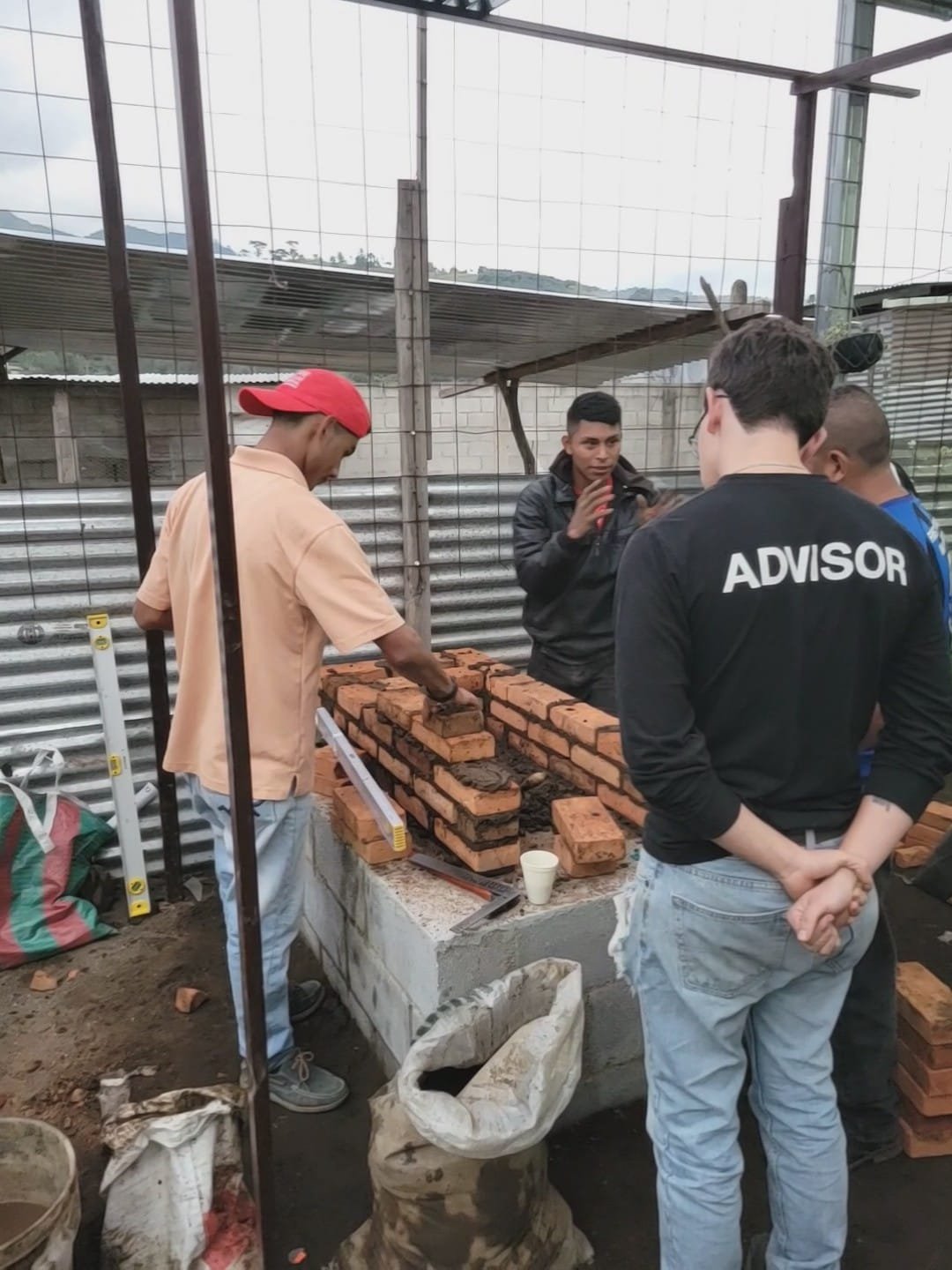
I was especially excited to participate in a Maestros Comaleros stove builder training academy. The Maestros Comaleros stove builder training academy is an intensive, three-day endeavor that pairs classroom theory with two days of hands-on building. Eighteen stove builders from Guatemala and El Salvador (17 men, and 1 woman) gained skills to educate families about the danger of open-fire cooking, the health and economic benefits of adopting the new stove, and the technical aspects of stove design. I am so impressed with the organization of this training, but mostly with our Guatemalan and El Salvadoran stove builders and trainers who are eager to learn and become masters at their skill. The technical part of this training is being led by 2 of our most successful women stovebuilders, Bety and Anibela.

I love being in the field because it reminds me WHY we do this work, and it’s wonderful to share our progress with our long-time supporters.
— Shelby Kardas, Executive Director

Meet the Trainers

Santos, graduated from the Maestros Comaleros training earlier in 2022. Santos has been building stoves in his home community of San Martín Jilotepeque,  and was recently asked to participate in this Maestros Comaleros training as a trainer. When he is not training new stovebuilders, or building new stoves, he is in charge of doing one-week follow-up visits on new stoves to ensure quality control and to collect surveys that help us analyze our adoption.

Click on this link to see Santos in action with several of his trainees building a stove inside a home.

StoveTeam’s women stovebuilders build a justa stove during Maestros Comaleros training

One of StoveTeam’s absolute superstars is Anibela. Our entire group was blown away by her enthusiasm and positive attitude. Watching Anibela work truly shows the nature of the Maestros Comaleros program which is intended not only to provide gainful employment and technical skill, but to encourage entrepreneurship in individuals.

Anibela is also a recent graduate of the Maestros Comaleros program, and due to her amazing work ethic and enthusiasm, she has quickly become one of our best stovebuilders and has been promoted to supervisor and trainer.

Anibela is just one of the women who make up our star stovebuilding team. We know that women are part of the solution, and we are building a stellar team of women stovebuilders and promoters who are essential to encouraging other women to adopt new technology. The best part of the training for me was the graduation. Seeing so many proud and happy faces also made me happy.  

In this photo left to right: Master Stovebuilders & Trainers, Anibela and Bety, new Maestra Comalera, Sylvia, Administrative Assistant in the Guatemala office, Rossi, and Guatemala Operations Director, Waleska.

“In the future, we hope to attract more women to this work, because women are awesome stovebuilders!
— Alex Eaton, Guatemala Country Director

Soon we will leave Guatemala, and head to Sonsonate, El Salvador to visit the factory of StoveTeam’s long-time factory partner Gustavo Peña. We hope you will continue to join us on this journey. Stay tuned…..

Help provide a stove